
The hydraulic separator was unable to perform its intended buffering function because primary flow volume consistently exceeded secondary circuit demand. Cold supply water recirculated back to the chiller inlet without absorbing heat from the distribution side, creating a false signal that triggered continuous compressor operation. The root cause was a combination of fixed-speed primary pumping and inlet-based control logic. After adjusting the control strategy to respond to actual return temperatures and demand, the thermal buffer began functioning correctly and compressor cycling was eliminated.
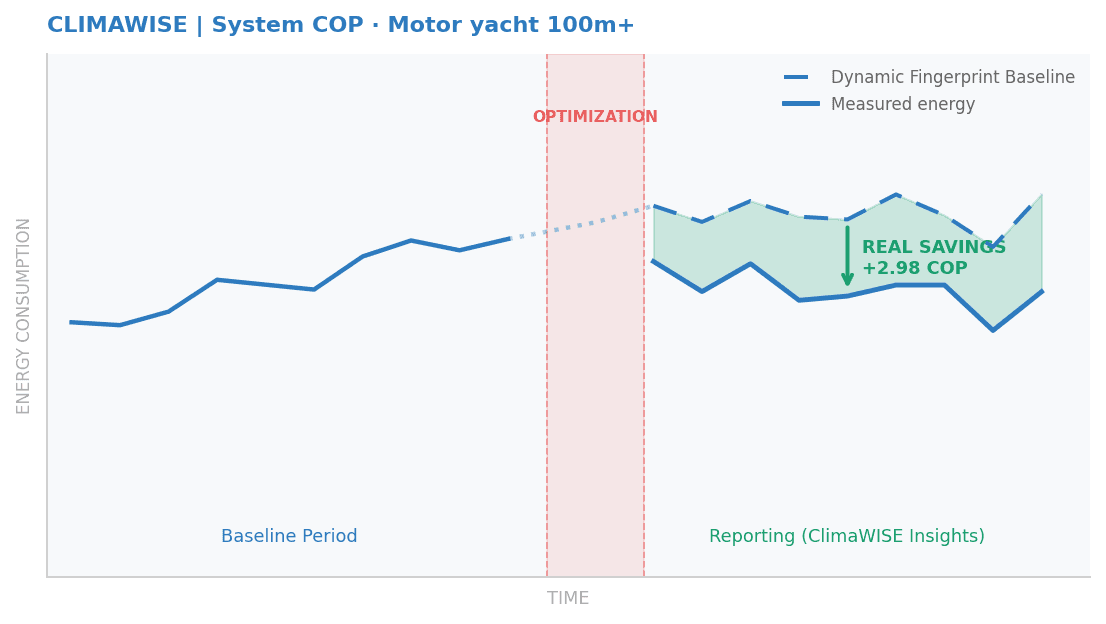
Compressor stability & thermal decoupling — motor yacht 100m+
System & context.
| Vessel type | Motor yacht 100m+ |
|---|---|
| Hydraulic layout | Open hydraulic divider, primary/secondary decoupled |
| Cooling distribution | Fan coil units via secondary chilled water circuit |
| Control issue | Inlet-based temperature control causing rapid cycling |
Despite the chiller plant being hydraulically separated into a primary and secondary circuit, the thermal decoupling was not functioning as designed. The primary pump maintained a constant high flow rate regardless of actual cooling demand, flooding the hydraulic separator with cold water and preventing warm return water from the secondary circuit from influencing chiller control. As a result, the chiller continuously saw a near-zero temperature differential and triggered compressor starts that were not needed. The system had no demand-based modulation in place and compressors ran at full capacity without interruption, causing excessive wear and energy waste.
What ClimaWISE found.
The fingerprint surfaces issues that show up nowhere else, not in the BMS, not in vendor diagnostics, not in scheduled service.
The chiller control system was configured to respond to supply water inlet temperature rather than return temperature. This caused the system to interpret normal temperature fluctuations as demand signals, triggering rapid start/stop sequences. By shifting the control reference and introducing a wider operating bandwidth, the system response became proportional to actual load rather than short-term temperature noise. System COP stabilised at 7.18 following the adjustments.
What changed.

Hydraulic separator now functioning as designed with measurable delta T between circuits.
Recognise this in your own installation?
Let us read your fingerprint.